
Table of Contents
- Antique Store Return Policy for a Damaged Item: What to Expect
- How to Report a Damaged Item to a Seller: A Step-by-Step Checklist
- Photos of Damaged Package and Item: What to Capture
- Shipping Damage vs. Pre-Existing Condition: Telling Them Apart
- Antique Return Request Email Template
- Shipping Insurance for Antiques and Carrier Claims
- When the Policy Falls Short: Escalation and Payment Disputes
- Frequently Asked Questions
Last Updated: October 18, 2026
Antique Store Return Policy for a Damaged Item: What to Expect
An antique store return policy for a damaged item usually covers refunds, replacements, or store credit when a piece arrives broken or not as described.
At Snellsantiquesstore, we ship one-of-a-kind pieces from Christmas, Florida, so we know a damaged delivery hits differently than a wrong-size sweater. You can't just swap it for another one.
Here's what most guides get wrong. They treat antiques like new retail goods. They aren't. Antiques are often sold as-is, and many stores mark pieces final sale.
Read the policy before you buy. Then keep the receipt, the order confirmation, and every photo you take.
How to Report a Damaged Item to a Seller: A Step-by-Step Checklist
Report a damaged item the same day it arrives. Open the package in front of a witness if you can, photograph everything before you touch it, and contact the seller in writing within 24 to 48 hours. Speed and evidence win claims.
Here's the checklist we'd follow ourselves:
- Photograph the box before opening, including any dents, tears, or water marks
- Film a short unboxing video showing the sealed package and the item inside
- Capture the damaged item from multiple angles in good light
- Save the original packaging and all packing materials
- Locate your proof of purchase: receipt or order confirmation
- Screenshot the listing description and photos
- Email the seller with photos attached and a clear subject line
- Request a return authorization number before shipping anything back
- Note the date you reported the damage and who you spoke with
A common mistake is tossing the box. Without it, a carrier claim is nearly impossible, and the seller can argue the damage happened after delivery.
Photos of Damaged Package and Item: What to Capture
Capture six types of photos: the outer box, the shipping label, the packing materials, the full item, close-ups of the damage, and the item next to the box. These six shots tell the whole story and answer the seller's first questions before they ask.
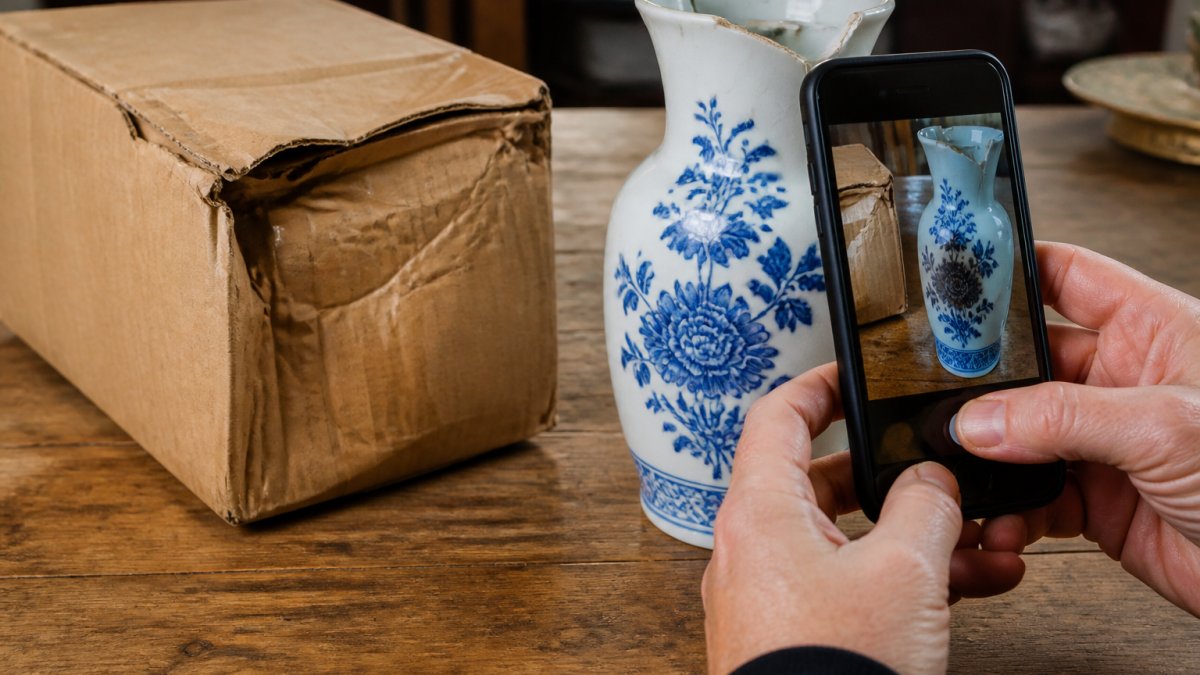
Specific shots to take:
- Outer box: every side, especially crushed corners and punctures
- Shipping label: readable, with the tracking number visible
- Packing materials: how the item was cushioned, or how it wasn't
- Full item: straight on, so wear and damage can be compared to the listing
- Damage close-ups: with a coin or ruler for scale
- Box and item together: proves they belong to the same delivery
Good lighting matters more than a good camera. Daylight near a window beats a flash every time.
Shipping Damage vs. Pre-Existing Condition: Telling Them Apart
Shipping damage shows fresh breaks, clean edges, and loose fragments. Pre-existing condition shows old repairs, worn edges, and patina that matches the listing photos. The difference decides who pays.
Look for these clues:
- Fresh damage: sharp, clean breaks; splinters; pieces rattling loose in the box
- Old damage: darkened cracks, glue lines, filled chips, wear that appears in the listing photos
- Shipping stress: cracks radiating from where the item pressed against packing
- Pre-existing faults: hairline cracks disclosed in the description
This is where antique condition gets tricky. A vintage piece may arrive with the exact wear the seller described. That's not damage; that's age. But if the listing said "no cracks" and a crack shows up, you have a claim.
Many sellers photograph wear in the listing for this reason. Compare your item to those photos before you report a problem.
Antique Return Request Email Template
Use a short, factual email. State what you bought, what arrived, what's wrong, and what you want. Attach photos and ask for a return authorization. Keep the tone calm and specific.
Here's a template you can copy:
Subject: Damage Report - Order [number] - [item name]
Hello [seller name],
I received order [number] on [date]. The [item name] arrived damaged. The [describe damage: e.g., handle snapped off, base cracked] does not match the listing description, which stated [quote the listing].
I've attached photos of the packaging and the damage. I'd like to request a return authorization and a [refund / replacement / store credit]. Please let me know the next steps and who covers return shipping.
I'm happy to provide more photos or details.
Thank you, [Your name] [Order number] | [Phone] | [Email]
What most guides miss: ask for the return authorization in the first email. Shipping an item back without approval can void your refund.
Shipping Insurance for Antiques and Carrier Claims
Shipping insurance for antiques covers loss or damage in transit, but the claim almost always belongs to whoever purchased the label. If the seller bought the label, the seller is the claimant and you are the evidence provider.
Here is how carrier claims actually work in practice:
- The shipper of record files. Carriers contract with the person or business that bought the label. A receiver generally cannot open a claim on someone else's account.
- Declared value is the ceiling, not the payout. Insurance reimburses up to the declared value, minus any deductible, and only for the covered loss. If the declared value was set below the purchase price, the gap is usually unrecoverable from the carrier.
- Packaging is part of the claim. Carriers commonly require the original box and packing materials to be available for inspection. Discarding them can sink an otherwise valid claim, which is why buyers should hold everything until the seller or carrier says otherwise.
- Deadlines are short and service-specific. Carriers publish their own claim windows measured from the delivery date, and the window can differ by service level. Confirm the current window on the carrier's site before relying on it.
- Photos and documents drive the decision. Expect to supply images of the outer box, the label, the packing materials, the item, and the damage, plus proof of value such as the order confirmation or receipt.
A common pattern: the seller files the carrier claim, the carrier pays the seller the declared value, and the seller then refunds you. That sequence means your job is to give the seller a complete evidence package fast, clear photos, the listing screenshots, and a written statement of what arrived versus what was described.
One more distinction matters for antiques: insurance covers transit damage, not pre-existing condition. If the piece arrived with the wear the listing disclosed, the carrier will treat it as not a covered loss. That is why the shipping-damage-versus-pre-existing analysis above is the foundation of any insurance claim, the carrier and the seller will both ask the same question.
When the Policy Falls Short: Escalation and Payment Disputes
Escalate in order: seller, then payment provider, then consumer protection. Each step has its own rules and evidence standard, and skipping a step or missing a deadline can cost you the claim. Here is how each level actually works.
Step 1, The seller, in writing. Send a follow-up that restates the order, the damage, the listing language the item failed to match, and the resolution you want.
Step 2, The payment provider. Two different paths exist, and they are not interchangeable:
- Card chargeback. If you paid by credit or debit card, you can dispute the charge with your card issuer. The issuer will ask for your evidence: the order confirmation, the listing description, your photos, and your written attempts to resolve the issue with the seller. Chargebacks are governed by the card networks' dispute rules, and issuers generally expect you to have contacted the seller first. Time limits apply and are set by the card network and issuer, so file promptly rather than waiting on a seller who has gone quiet.
- Platform or payment-app claim. If you paid through a marketplace or a payment platform, that platform's buyer-protection process usually applies instead of, or before, a card chargeback. These processes have their own deadlines and evidence requirements, and filing a card chargeback while a platform claim is open can complicate both.
Step 3, Consumer protection. If the seller will not resolve a valid claim, your state attorney general's consumer protection office is the usual place to file a complaint. The FTC's Mail, Internet, or Telephone Order Merchandise Rule is also relevant for ordered goods: it addresses shipping timelines and the seller's obligation to offer cancellation when an order cannot be shipped as promised (the FTC).
Step 4, Legal help. For a high-value piece, a consumer rights attorney may be worth a consultation. The cost usually only makes sense when the item's value is well above the legal fees.
In-person purchases follow a different path. Store policy governs, and many antique shops post "all sales final" at the register. Ask for any return terms in writing before you pay, and if damage is discovered after you get the piece home, contact the store immediately and document the condition. For online purchases, the Consumer Financial Protection Bureau's guidance on disputing charges explains how chargebacks work and what evidence helps.
Frequently Asked Questions
Can you return an antique if it arrives damaged?
Yes, most antique stores allow a return or another resolution when an item arrives damaged, but the store's written return policy sets the terms. Check the return window, typically short, and report the damage immediately with photos of the packaging and item. Because antiques are often one-of-a-kind, a replacement may not exist, so ask about a refund or store credit. If the listing disclosed existing wear, that condition is not treated as shipping damage.
What should I do if an antique is damaged during shipping?
Keep the box and all packing materials, photograph the damage from several angles, and contact the seller within the reporting deadline in the return policy. Save your order confirmation and delivery receipt as proof of purchase. Ask the seller whether they will file a carrier claim or whether you need to. If the store does not respond, you can escalate to a payment dispute with your card issuer. Prompt reporting and clear photos make the process faster.
How soon should I report damage to an antique seller?
Report the damage as soon as you unpack the item, ideally the same day it arrives. Many antique store return policies set a short window, often 48 to 72 hours from delivery, though the exact time limit varies by store. Waiting can weaken your claim because the seller may argue the damage happened after delivery. Send your first message in writing so you have a dated record of when you reported the problem.
Who is responsible if an antique is damaged during delivery?
Responsibility depends on the store's policy and the shipping terms. Many sellers handle carrier claims themselves and refund or credit the buyer, while others ask the buyer to file the claim. Shipping insurance for antiques can cover the loss, but only if the item was packed to the carrier's standards and the claim is filed on time. Review the policy before you buy so you know who files the claim and what evidence is required.
A damaged antique is stressful, but a clear paper trail turns it into a solvable problem. At Snellsantiquesstore, every piece ships from Christmas, Florida, carefully packed and chosen for collectors who care about condition and provenance. If something arrives less than perfect, our curated approach means we work with you directly, from photos to resolution. Browse our collections and buy with the confidence that a real person is on the other end when a package needs attention.