
Table of Contents
- What Qualifies as High End Antique Furniture for Sale
- Curated High End Antique Furniture for Sale: Our Top Picks
- How to Identify Antique Furniture Before You Buy
- Antique Furniture Value: How Price Is Set and What to Expect
- Restoring Antique Furniture Without Damaging Its Worth
- Antique Furniture Care for Long-Term Ownership
- Conclusion
- Frequently Asked Questions
Last Updated: October 19, 2026
What Qualifies as High End Antique Furniture for Sale
High end antique furniture for sale is not simply old wood with a high price tag. It is furniture that has passed the century mark, survived intact, and carries documented craftsmanship modern production cannot replicate. At Snellsantiquesstore, we judge three things before calling a piece "high end": age, construction, and condition, and condition is where buyers get burned.
The 100-Year Rule and Why It Still Matters
The 100-year rule is the informal standard most dealers use: furniture becomes antique at roughly 100 years old. A piece made in 1920 is antique in 2026; one made in 1975 is vintage, no matter how it is marketed.
That distinction matters for value. Antique status signals a production era that ended before modern manufacturing: hand-cut joinery, older wood stock, and finishes that aged rather than being sprayed on.
Craftsmanship Signals That Separate High End from Ordinary
Construction tells you more than any label. Look for hand-cut dovetail joints on drawer corners rather than stapled or nailed boxes. Check whether the wood is solid or veneer over particleboard.
Then look at the finish. A maintained oil-rubbed surface shows depth and patina; a heavy polyurethane coat usually means a recent refinish, which can reduce value on a genuine antique.
Curated High End Antique Furniture for Sale: Our Top Picks
Our top picks come from our own curated collection, chosen for authenticity, condition, and character that only comes with age. Each is a one-of-a-kind find with a documented origin.
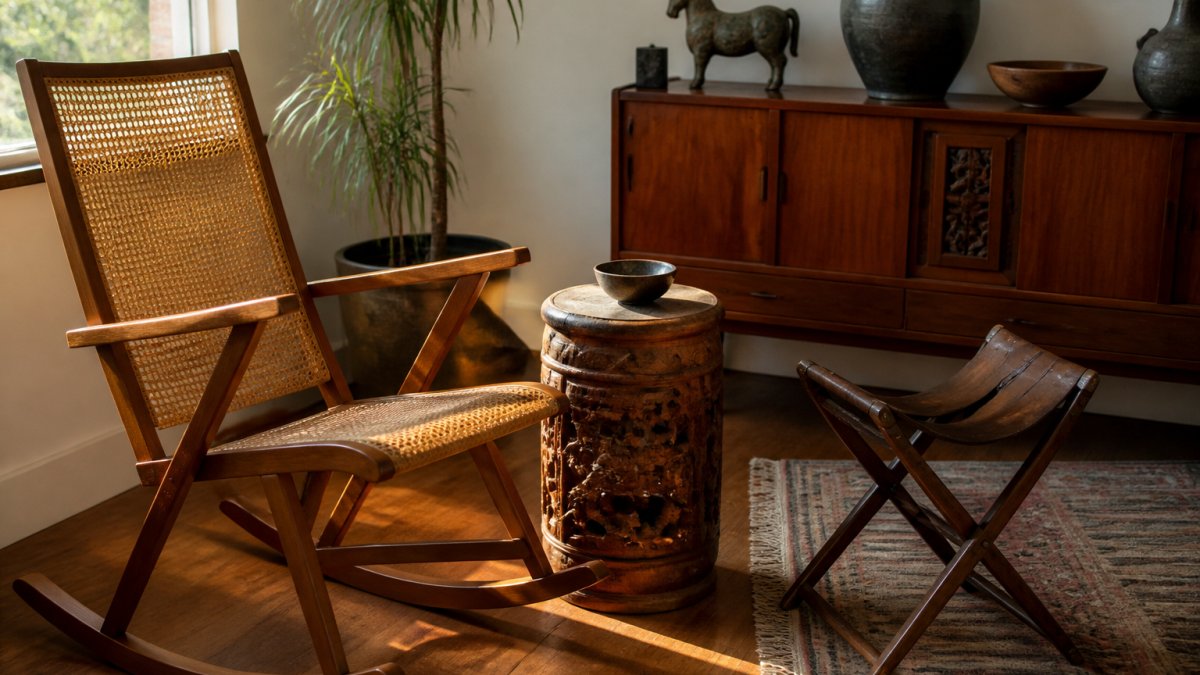
Bramin Møbler Frank Reenskaug Mid-Century Danish Rocking Chair in Teak
Our first pick is the Bramin Møbler Frank Reenskaug Mid-Century Danish Rocking Chair in Teak, priced at $1,356.00.
The chair includes a cushion and a working rocker, and it is handmade. Most rocking chairs are either comfortable reproductions or authentic pieces too fragile to sit in; this one is both usable and original.
Best for: Buyers who want a statement piece they can actually use every day.
Antique Wood Carved Tree Congo Chief's Stool
The Antique Wood Carved Tree Congo Chief's Stool is our most culturally significant offering at $1,196.00. Handmade from wood in the early 1900s, it features intricate carvings and a round top that works as a vanity stool, bench, or sculptural side table.
At 13 inches long and 10.5 inches wide, it suits small spaces and is rated for indoor and outdoor use. Pieces like this carry a narrative mass-produced furniture cannot, a large part of what you are buying.
Vintage Slotted Wooden Child or Doll Folding Chair
At $52.00, the Vintage Slotted Wooden Child or Doll Folding Chair is the entry point into collecting: 22 inches tall, 13 inches wide, 4 pounds, folds flat, natural wood, high back, early 1900s origin.
We recommend it to gift-givers and anyone styling a child's room with vintage character. It works indoors and outdoors and stores easily, not every collector starts with a four-figure purchase.
Best for: First-time buyers, nursery styling, and nostalgic gifts.
| Piece | Price | Era | Best For |
|---|---|---|---|
| Bramin Møbler Teak Rocking Chair | $1,356.00 | Mid-century | Daily-use statement seating |
| Carved Tree Congo Chief's Stool | $1,196.00 | Early 1900s | Accent table, sculptural display |
| Slotted Wooden Folding Chair | $52.00 | Early 1900s | Gifts, nursery styling, small spaces |
How to Identify Antique Furniture Before You Buy
Identifying antique furniture takes more than four quick checks. Joinery, hardware, wood, and wear tell you whether a piece is old; authentication and provenance tell you whether it is what the seller says it is. Run both layers before you commit.
The Physical Checks
Joinery. Hand-cut dovetails are irregular and slightly asymmetrical. Machine-cut dovetails are perfectly uniform.
Hardware. Hand-forged nails and screws with off-center slots point to older production.
Wood. Look at the secondary wood inside drawers and on the back panel. Genuine antiques use solid stock throughout.
Wear. Authentic age shows in predictable places: drawer runners, chair arms, and the base of legs.
Authentication: Maker Marks, Labels, and Signatures
A maker's mark is the strongest authentication signal short of full documentation. Check the underside of seats, the back of case pieces, drawer bottoms, and the inside of legs for stamped signatures, paper labels, brand stamps, and metal tags.
Beware the common failure modes: marks added later to ordinary pieces, labels transferred from damaged furniture, and convincing fake stamps on reproductions.
Provenance and Documentation Checks
Provenance is the paper trail: receipts, auction records, estate inventories, family histories, and appraisals. Ask what documentation accompanies the piece and request copies before payment.
For research, the Smithsonian Institution's conservation guidance is a useful reference for understanding how materials age and what authentic patina looks like, and public archival collections can help you trace makers and periods.
Repairs, Restorations, and Misrepresentation Red Flags
Original condition commands a premium, so ask directly whether a piece has been repaired, refinished, or restored, and get the answer in writing.
Bramin Møbler Frank Reenskaug Mid-Century Danish Rocking Chair Teak →
Watch for these signals:
- Mismatched finish. A drawer front that is a slightly different color or sheen than the case often means replacement or repair.
- New wood in old furniture. Fresh, bright wood inside a joint or under a repair patch indicates recent work.
- Over-restoration. A piece that looks brand new despite being a century old has likely been stripped and refinished, which can reduce value.
Antique Furniture Value: How Price Is Set and What to Expect
Antique furniture value rests on five factors: rarity, condition, provenance, maker, and current demand. No single factor decides price, a rare piece in poor condition can be worth less than a common piece in excellent original condition.
Realistic Price Bands by Category
High-end antique furniture does not have a single price. It clusters into bands, and knowing the band tells you whether an asking price is plausible before you negotiate.
- Entry collectible: under $500. Small accent pieces, child or doll furniture, carved stools, and single chairs. At this level you are buying character and a story, not investment grade. A vintage folding chair or a small carved stool fits here.
- Mid-tier usable antiques: roughly $500 to $2,500. Everyday seating, side tables, small case pieces, and mid-century designer chairs with documented makers. This is where most first serious purchases land, and where condition and maker marks move the price most.
- Upper mid-tier: roughly $2,500 to $10,000. Statement seating, dining tables, chests, and named-designer pieces in strong original condition. Provenance documentation starts to matter more than the object itself at this level.
These bands are guides, not rules. A common piece in exceptional original condition can outperform a rarer refinished one, and regional demand shifts the numbers. Use the band to spot outliers, then verify with the checks below.

How to Sanity-Check an Asking Price
A price without context is a guess. Before you commit, run three comparisons.
Comparable sales, not comparable listings. Asking prices are wishes; sold prices are facts. Auction result databases and dealer archives show what pieces actually fetched.
Maker premium. A documented maker's mark, original label, or signature can justify a meaningful premium over an unattributed piece of similar construction.
What Buyers Underestimate
Provenance is the factor buyers underestimate most. The Antiques and Collectibles guide from the Library of Congress explains how to research provenance through archival records.
Condition carries the most weight in practice. Original finish and hardware almost always beat a restoration, even when the restoration looks better. Buyers pay for authenticity, not shine. Age alone is not value, a 150-year-old common table can be worth less than a 60-year-old signed designer chair.
Restoring Antique Furniture Without Damaging Its Worth
Restoring antique furniture is where well-meaning owners destroy value. Our rule for every customer: clean, stabilize, and stop.
Start with the gentlest method. Dust with a soft brush. Clean with a mild solution and a barely damp cloth.
Structural repairs are different. The National Park Service preservation briefs cover reversible repair methods in detail and are worth reading before you touch a tool.
Antique Furniture Care for Long-Term Ownership
Antique furniture care is mostly about controlling the environment. Wood moves with humidity, and rapid swings cause cracking, warping, and joint failure.
Aim for stable indoor humidity and avoid placing furniture against exterior walls that sweat.
For routine care, dust weekly with a soft cloth and wax finished surfaces a few times a year.
Store seasonal pieces in a climate-controlled space, never a garage or attic.
Conclusion
The hardest part of buying high end antique furniture for sale is not finding pieces. It is knowing which ones are worth the money and how to keep them that way.
At Snellsantiquesstore, we curate rare finds and ship each order from Christmas, Florida, packed to feel like a gift when it arrives. Browse our collection of antiques, jewelry, art, and collectibles, and add the piece that gives your space a story.
Frequently Asked Questions
How can you tell whether antique furniture is authentic?
Start with joinery: hand-cut dovetails, wooden pegs, and irregular saw marks point to older construction, while uniform machine cuts suggest a later reproduction. Check for a patina that has built up evenly over decades, and look underneath for wear patterns that match how the piece was used. Original labels, maker's stamps, and provenance paperwork help, but they can be faked. Ask the seller for close-up photos of joints, the back, and the underside before you commit, and compare hardware against known period examples.
What should you check before buying high end antique furniture for sale online?
Request detailed condition notes covering cracks, veneer lifting, repairs, and replaced hardware, plus measurements and high-resolution photos from several angles. Confirm the seller's return policy and how damage claims are handled, since one-of-a-kind pieces cannot be swapped for an identical replacement. Ask about shipping method and insurance for large items. Finally, verify the wood species and finish so you can plan antique furniture care correctly once the piece arrives.
Is restored antique furniture worth buying?
Often yes, if the restoration was conservative. A piece that has been cleaned, waxed, or had structural repairs done with reversible materials keeps most of its antique furniture value. Heavy refinishing, replaced veneer, or modern hardware can cut value significantly. Ask what was replaced and whether original surfaces remain. For everyday use, a well-restored piece is usually a better buy than a fragile original you are afraid to sit on, provided the price reflects the work done.
How do you find out how much vintage furniture is worth?
Compare recent sold prices, not asking prices, for the same maker, period, and condition. Auction records, dealer listings, and collector forums give a realistic range. Then adjust for condition: original finish, intact hardware, and documented provenance raise antique furniture value, while water damage, structural repairs, and missing parts lower it. Get a written appraisal for anything above a few thousand dollars, especially if you plan to insure it or resell later.
What types of antique furniture are in high demand right now?
Mid-century Danish and Scandinavian teak pieces, carved African and tribal stools, and small-scale accent furniture such as nightstands, coffee tables, and credenzas draw steady interest. Buyers with smaller homes favor compact, dual-purpose pieces over massive dining sets. Original condition and documented maker marks matter more than ever. Collectors also pay premiums for one-of-a-kind finds with a clear story, which is why curated collections tend to sell faster than mixed estate lots.
Buying an antique should feel like discovery, not a gamble. Snellsantiquesstore offers an expertly curated selection of rare antiques, jewelry, art, and collectibles, each chosen for authenticity and character. Every order ships directly from Christmas, Florida, and arrives packed with care. Explore our collections today and add a piece that brings history into your home.