
Last Updated: October 25, 2026
Quick Summary
The best Rau Antiques alternatives are specialty dealers with deep inventory in one or two categories, judged on documented condition and provenance, transparent pricing, a real return policy, and specialty fit. At Snellsantiquesstore, our pieces range from a $796 Sevres tea caddy to a $3,080 Martial Fray silver tea pot. Match the seller to the category you actually collect.
- Judge every alternative on documented condition and provenance, transparent pricing, a real return policy, and specialty fit.
- Named makers drive silver value, and the Martial Fray tea pot listing discloses an ebony handle repair.
- Pay by credit card or a platform with a dispute process, and avoid wire transfers with unfamiliar sellers.
- Save the listing text, photos, and seller messages before checkout, since sellers sometimes edit listings after a sale.
- Ask what a return would cost in practice, because return shipping and insurance can represent a real percentage of the price.
Table of Contents
- What Collectors Actually Need From a Rau Antiques Alternative
- A Curated Comparison of Rau Antiques Alternatives
- How to Buy Antiques Online Safely
- Antique Provenance and Authenticity: What to Verify Before You Pay
- Antique Dealer Return Policies: Read Them Before You Bid
- Antique Shipping and Insurance: Protecting One-of-a-Kind Pieces
- Choosing Pieces That Fit Your Collection and Your Budget
- Add a Rare Find to Your Collection From Snellsantiquesstore
- Frequently Asked Questions
What Collectors Actually Need From a Rau Antiques Alternative
The real question isn't which dealer has the biggest name. It's which one gives you enough information to buy with confidence.
That distinction matters more than most guides admit. A famous name and a high asking price don't guarantee a piece is right for your collection.
Below, we break down what to look for, how to compare options by category and budget, and how to buy antiques online safely.
The Four Criteria That Separate a Good Alternative From a Risky One
Every credible alternative should be judged on four things, and nothing else comes close in importance.
Transparent pricing. You should see the asking price, not a "contact us" wall.
A real return policy. One-of-a-kind pieces still need a written policy covering damage in transit and items that don't match the description.
Specialty fit. A dealer strong in French silver may be weak in porcelain. Match the seller to the category you actually collect.
A Curated Comparison of Rau Antiques Alternatives
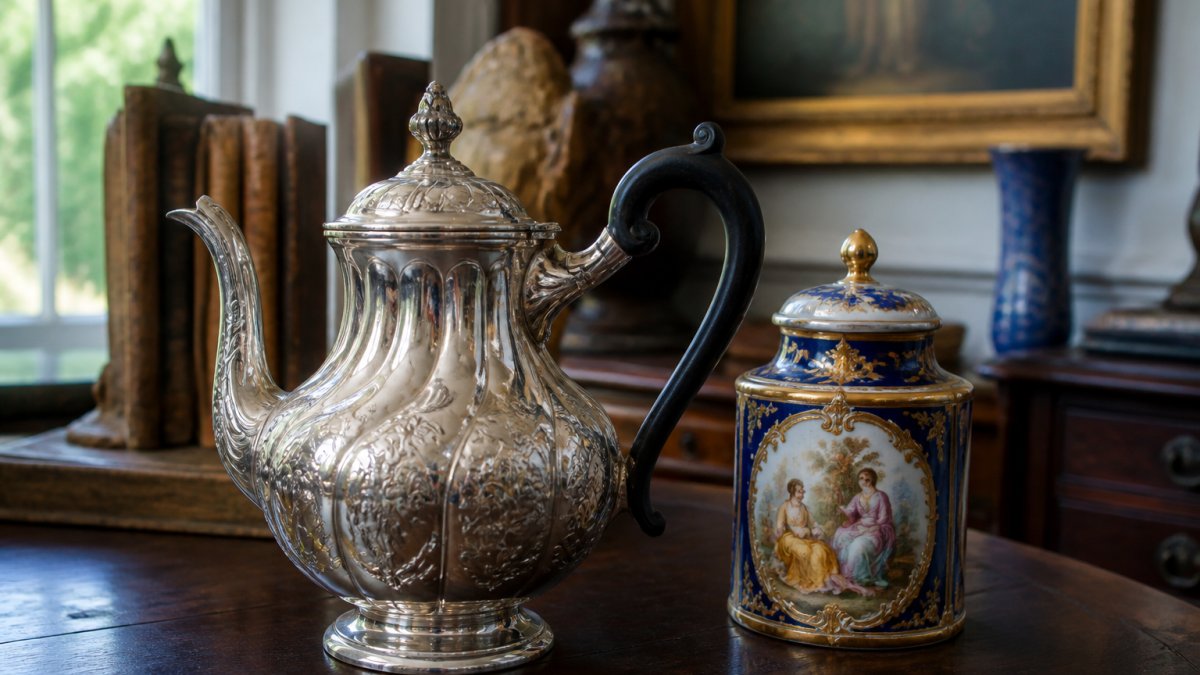
The strongest alternatives are specialty dealers with deep inventory in one or two categories. Here's how the pieces we carry compare across price, category, and buyer profile.
| Piece | Category | Price | Best For |
|---|---|---|---|
| Martial Fray French .950 Silver Tea Pot | French silver | $3,080 | Silver collectors seeking a named maker |
| Sevres Porcelain Tea Caddy | Porcelain | $796 | First-time buyers testing a dealer |
| Pair of Sevres Covered Urns | Decorative arts | $1,036 | Interior designers sourcing a statement pair |
| Set of 12 Monogram Sterling Plates | American sterling | $2,796 | Entertaining collectors and investors |
French Silver: The Martial Fray Tea Pot, $3,080
Named makers drive value in silver, and Martial Fray sits in that tier. This hand-chased .950 silver tea pot carries a floral Rococo pattern from the late 19th century, and the listing is upfront about the ebony handle repair. That honesty is exactly what you want to see before you pay. View the Martial Fray tea pot to inspect the chasing and the repair photos yourself.

Porcelain and Decorative Arts: Sevres Tea Caddy and Covered Urns
Porcelain rewards buyers who check marks and painting quality. The hand-painted Sevres tea caddy is a manageable entry point at $796, while the pair of 13-inch covered urns, at $1,036, suits a room that needs a focal point. Both carry the hand-painted detail collectors look for. You can inspect the Sevres tea caddy or review the covered urns before deciding.


American Sterling: The Set of 12 Monogram Bread and Butter Plates
American sterling has a steady following, and monogrammed sets are collected as much for display as use. This Art Deco set of twelve 6-inch plates, made between 1900 and 1940, runs $2,796. Note that one plate isn't monogrammed, a detail the listing states plainly. See the full sterling plate set for the monograms and condition.
How to Buy Antiques Online Safely
Safe online purchasing comes down to three habits: verify the seller's reputation, read the listing line by line, and pay through a channel that protects you. But antiques add wrinkles that generic online-shopping advice ignores, one-of-a-kind inventory, condition that is hard to photograph, and sellers who range from single-owner shops to auction houses that sell "as is." The checks below are organized by the type of seller you're buying from, because the risks are not the same.
Match your safety checks to the seller type
Specialist dealer websites. These sellers usually publish an asking price, a condition report, and a return window. Your job is to confirm all three in writing before checkout.
Auction platforms and auction houses. Here the risk shifts.
Peer-to-peer marketplaces. These carry the widest quality range and the thinnest seller vetting. Reputation scores help, but they can be gamed.
Payment methods and what they actually protect
Payment choice determines your recourse more than any other single decision.
- Credit and debit cards. Card purchases generally carry dispute rights when goods arrive not as described or never arrive. This is the strongest default for online antique purchases.
- Platform checkout with escrow-style release. Some marketplaces hold funds until delivery is confirmed. That protects you against non-delivery, though not always against misdescription.
- Wire transfer and peer-to-peer payment apps. These generally remove your ability to dispute a charge. Avoid them with sellers you have not bought from before.
Paying by wire transfer or a peer-to-peer app can eliminate your ability to dispute a charge. Use a card or a platform with a formal dispute process, especially on a first purchase from any seller.
Preserve the record before you pay
Save the listing text and photos before checkout, because sellers sometimes edit listings after a sale. Screenshot the condition notes, the stated return window, and any email or message where the seller describes the piece.
The Federal Trade Commission's guidance on online shopping explains your rights when an item arrives not as described, and it is worth reading before a high-value purchase rather than after one.
A quick pre-purchase checklist
- Confirm the seller's return window and who pays return shipping.
- Ask for photos of every flaw the listing mentions.
- Ask directly whether the piece has been repaired or restored.
- Pay by card or a platform with a dispute process.
- Save the listing and all seller messages before checkout.
Run that checklist on every purchase, and the safety question becomes a matter of routine rather than guesswork.
Antique Provenance and Authenticity: What to Verify Before You Pay
Provenance is the documented history of ownership, and authenticity is proof the piece is what it claims to be.
Martial Fray French .950 Silver Tea Pot Hand Chased 1875-91 →
Ask for maker's marks, date letters, and any auction or estate paperwork. For silver, look for the maker's stamp and purity mark.
A common mistake is accepting a verbal attribution without documentation. If a seller calls a piece "museum-quality," ask what supports that claim.
Antique Dealer Return Policies: Read Them Before You Bid
Return policies for antiques vary widely, and the differences matter most when a piece arrives damaged, unlike the photos, or suspected to be inauthentic. Most guides stop at "check the return window." The more useful exercise is to compare how recourse works across the three main seller types, because the policy language is not interchangeable.
How recourse differs by seller type
Auction houses. Many auction houses sell "as is," with no returns for condition issues, and condition reports are provided as a courtesy rather than a warranty.
Peer-to-peer marketplaces. Recourse here depends on the platform's dispute process rather than the seller's own policy. Platform protection may cover non-delivery and clear misdescription, but it rarely covers subjective questions like condition or attribution.
The three clauses that decide your risk
Look for three things in writing: the return window, who pays return shipping, and how damage in transit is handled. A fourth clause matters just as much on higher-value pieces: whether the seller offers store credit rather than a refund. Store credit changes your risk profile, because a refund returns your money while credit keeps it with the seller.
A generous return window with buyer-paid return shipping on a fragile porcelain piece can cost more than a shorter window with seller-paid shipping. Compare the total cost of a return, not just the number of days.
What to do when a piece arrives misdescribed or damaged
- Document immediately. Photograph the packaging and the piece before you discard anything, and note the condition of the shipping carton.
- Notify the seller in writing within the return window, stating clearly whether you are requesting a return, a replacement, or a repair credit.
- Keep the original packaging until the dispute is resolved; many carriers require it for a damage claim.
- Escalate through your payment channel if the seller does not respond. Card disputes and platform dispute processes exist for exactly this situation.
- Get an independent opinion if authenticity is the issue. A written appraisal from a qualified appraiser carries more weight than a buyer's own assessment.
For a deeper look at what to do when a piece arrives damaged, our guide to antique store return policies for damaged items walks through the process step by step.
The cost side of returns
Return shipping on a large or fragile piece is not trivial. A fitted crate, insured transit, and signature delivery can add meaningful cost to a return, and some dealers pass that cost to the buyer. Before you buy, ask what a return would cost in practice, not just whether one is allowed. On a piece in the low four figures, return shipping and insurance can represent a real percentage of the purchase price, and that belongs in your comparison alongside the asking price.
Antique Shipping and Insurance: Protecting One-of-a-Kind Pieces
Shipping is where many online purchases go wrong. A piece can't be replaced, so insurance and packing quality matter as much as the price.
Confirm the carrier, the packing method, and who insures the shipment before you buy. Ask whether the seller ships in a fitted crate for larger pieces and whether signature delivery is included.
Many collectors find that paying for professional packing is cheaper than repairing a chipped porcelain rim.
Choosing Pieces That Fit Your Collection and Your Budget
Budget should shape category, not just price. A collector with $800 to spend is better served by a single strong porcelain piece than by a marginal silver item.
Match the piece to how you'll live with it. Display collectors want condition and visual impact. Investors want named makers and documented provenance.
If you're new to collecting, start with one piece from a dealer whose descriptions you trust.
Add a Rare Find to Your Collection From Snellsantiquesstore
Building a collection takes patience, and the hardest part is finding a dealer whose descriptions you can trust before the piece arrives.
Our inventory spans French silver, Sevres porcelain, American sterling, and decorative arts, each piece chosen for craftsmanship and historical significance.
Get started with Snellsantiquesstore and add a documented, rare find to your collection this season.
Frequently Asked Questions
What are the best Rau Antiques alternatives for collectors?
Look for dealers that specialize in a narrow category, publish detailed condition notes, and state a clear return window. A curated shop such as Snellsantiquesstore focuses on fine silver and porcelain with item-level descriptions, including repairs and monograms. Compare asking prices against auction estimates, confirm what buyer protection applies, and ask for provenance documentation before you commit. The right alternative is the one whose specialty matches your collection and whose policies you can verify in writing.
How can I buy antiques online safely?
Start with the seller's reputation and reviews, then read the full listing for condition, repairs, and measurements. Pay through a method with dispute rights, such as a credit card or a platform with buyer protection, and avoid wire transfers to unfamiliar sellers. Ask for additional photos under natural light. Keep every message and invoice; if the piece arrives not as described, that record supports a refund claim under the dealer's return policy.
How do I verify an antique's provenance and authenticity?
Ask for the documented chain of ownership, maker's marks, hallmarks, and any appraisal or certificate. On silver, check the maker and standard marks against the country of origin; on porcelain, examine the factory mark and the quality of the hand painting. A written description that names repairs, as with an ebony handle restored on a 19th-century tea pot, is a sign of an honest listing. When the value is high, commission an independent appraisal before purchase.
What should an antique dealer's return policy include?
A workable policy states the return window in days, who pays return shipping, and how a not-as-described claim is handled. Because antiques are one-of-a-kind, most dealers offer a refund rather than a replacement, so confirm that in writing. Ask whether the policy covers damage in transit and whether insurance is included. Get the terms before you pay, since a generous-sounding policy with no stated window is difficult to enforce.
How are antiques shipped and insured?
Reputable dealers pack porcelain and silver with padded, custom-fit materials and ship via carriers that offer tracking and declared-value coverage. Confirm who arranges insurance, what the declared value is, and how a damage claim is filed. Photograph the box and the piece before opening it fully, and report damage within the carrier's claim window.
