
Last Updated: October 28, 2026
Quick Summary
Styling antique statement pieces works best when one piece leads and everything else supports it, so start with a single anchor rather than buying five antiques at once. Mix vintage and modern decor by sharing a color, shape, or finish between the two sides, and place the piece where the eye already goes.
- Use one large antique plus one or two small antique accessories per room.
- Pick a three-color palette: one neutral, one warm, one accent, letting the antique supply the accent.
- A statement piece should occupy roughly one-third to one-half of the wall width it sits on.
- Keep at least 36 inches of clear floor where people move, and 42 to 48 inches in a main path.
- Layer a table lamp, floor lamp, and soft accent light using warm bulbs around 2700K.
Table of Contents
- Start With One Antique Statement Piece, Not Five
- How to Mix Vintage and Modern Decor Without a Style Clash
- Antique Furniture Focal Point Ideas That Anchor a Room
- How to Decorate With Antique Furniture: Scale, Proportion, and Placement
- Modern Home Antique Decor Ideas, Room by Room
- Lighting and Layering: Making the Piece Read as Modern
- Keeping Antiques From Looking Cluttered, Damaged, or Out of Place
- Find Your Statement Piece in the Curated Collection
- Frequently Asked Questions
Start With One Antique Statement Piece, Not Five
The fastest way to ruin a room is to buy five antiques at once. Styling antique statement pieces works when one piece leads and everything else supports it.
One piece gives the eye somewhere to land. Two compete. Five create noise.
How Many Antique Pieces Belong in One Room
A good rule for most rooms is one large antique plus one or two small antique accessories. The large piece is your anchor: a rocking chair, a chest, a table. The small pieces are accents: a bowl, a lamp, a rug.
- Small rooms: one antique, full stop
- Living rooms: one large piece plus two small accents
- Bedrooms: one large piece, skip the rest
A collected interior builds slowly, over months and years. Buy the anchor first. Live with it. Then add.
How to Mix Vintage and Modern Decor Without a Style Clash
Mixing vintage and modern decor works when the two sides share something: a color, a shape, or a finish. Without a shared thread, the room reads as two rooms shoved together.
Start with what the antique already gives you. A teak chair brings warm brown wood and clean mid-century lines. A cobalt blue lamp brings a strong color.
- Repeat the wood tone in a modern frame or shelf
- Echo the antique's color in a cushion or throw
- Match metal finishes within a room, not across the house
Pairing Colors and Materials That Hold Together
A cohesive color scheme is the glue. Pick a palette of three colors: one neutral, one warm, one accent. Let the antique supply the accent.
Material pairing matters just as much. Shiny modern surfaces next to matte old wood feel like a fight. Pair warm wood with linen, wool, or leather. Pair glossy ceramic with glass or polished metal.
Antique Furniture Focal Point Ideas That Anchor a Room
Antique furniture focal point ideas work best when the piece sits where the eye already goes: the end of a sightline, across from the entry, or beside the fireplace.
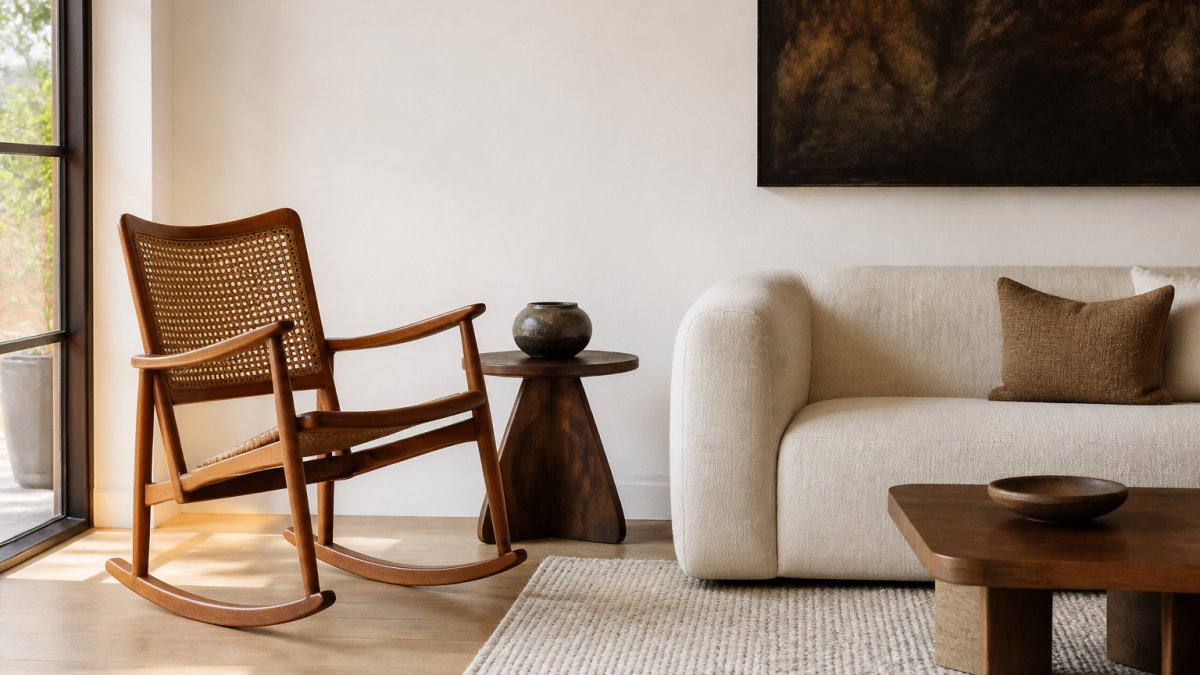
A few layouts that work in modern homes:
- A vintage armchair alone in a corner with a floor lamp and a small side table
- An antique chest used as a console behind a modern sofa
- A pedestal bowl on a bare dining table as the only decoration
If you want a single anchor to build around, our mid-century Danish teak rocking chair shows how one piece can carry a whole corner without help.

How to Decorate With Antique Furniture: Scale, Proportion, and Placement
Scale is where most modern homes go wrong. A tall chest can swallow a small bedroom whole. The fix is not to avoid large pieces, it is to size and place them on purpose. Below is a practical method you can run before you buy.
Measure the Piece Against the Wall, Not the Room
A large piece needs wall to breathe against. As a working rule, a statement piece should occupy roughly one-third to one-half of the wall width it sits on, with visible wall on both sides.
Height matters just as much. The top of a tall antique should sit below the ceiling by at least 18 to 24 inches so the eye reads air above it.
Protect the Walkway Before You Fall in Love
Measure the clear floor, not the room. You want at least 36 inches of clear floor where people move, and 42 to 48 inches in a main path or in front of a sofa. A piece that blocks traffic can feel out of place. In a small room, a narrow console (12 to 14 inches deep) often does more than a deep chest because it preserves the walkway.
Read Visual Weight, Then Lighten It
Proportion is about visual weight. A heavy dark piece needs breathing room around it. Three levers lighten a heavy antique without changing it:
- Open modern furniture nearby. A glass or open-frame side table next to a dark chest keeps the corner from feeling top-heavy.
- A light wall behind it. Pale walls make dark wood read as a deliberate contrast rather than a mass.
- A rug that extends past the piece. A rug that ends at the front feet of a heavy piece makes it look planted; one that extends 12 to 18 inches beyond the sides makes it look intentional.
Place It Where the Eye Already Goes
Placement follows three checks:
- Does the piece sit against a wall with room to spare on both sides?
- Does it face into the room rather than at a wall?
- Does it have a job, or is it just standing there?
A fourth check is sightline. Stand at the main entry to the room. The antique should land at the end of that sightline, not off to the side. If it sits beside the fireplace, center it on the mantel rather than the wall, because the mantel is what the eye tracks.
Solve Scale Problems With Small Pieces
A small antique rug can help define a seating zone. A 2 x 4 ft or 3 x 5 ft rug defines a seating zone without crowding it, and it visually anchors a piece that would otherwise float. Our handmade Chinese wool rug shows how a small rug can do that work under a chair or at the foot of a bed.

If you are unsure, size down. A slightly small antique with air around it reads as collected; a slightly large one with no air reads as crowded, no matter how good the piece is.
These are the working measurements the article gives for sizing and placing an antique statement piece.
Bramin Møbler Frank Reenskaug Mid-Century Danish Rocking Chair Teak →
| Item | Value | Note |
|---|---|---|
| Statement piece vs wall width | One-third to one-half of wall width | Visible wall on both sides |
| 60-inch chest on 10-foot wall | About 30 inches each side | Comfortable fit |
| Ceiling clearance above tall antique | At least 18 to 24 inches | Keeps air above the piece |
| Clear floor where people move | At least 36 inches | Main path or sofa front: 42 to 48 inches |
| Narrow console depth | 12 to 14 inches | Preserves the walkway in small rooms |
| Rug extending past heavy piece | 12 to 18 inches beyond sides | Makes placement look intentional |
| Small antique rug sizes | 2 x 4 ft or 3 x 5 ft | Defines a seating zone |
Modern Home Antique Decor Ideas, Room by Room
Most styling advice stops at "mix old and new." What actually helps is a plan for each room, because a living room, a bedroom, and an entryway ask an antique to do different jobs. Below are working recipes for the five rooms where antique statement pieces earn their keep. Treat the dimensions as starting points, not code.
Living Room: One Anchor, One Light, One Textile
Put the anchor on the longest uninterrupted wall, centered on the seating group rather than the wall itself. A sofa facing the piece at 8 to 10 feet gives the eye a comfortable read. Keep the coffee table low (16 to 18 inches) so it does not compete with a tall antique. Add one lamp at 58 to 64 inches to the shade top and one textile, a wool throw or a 5 x 8 ft rug, and stop.
Bedroom: Let the Antique Be the Only Old Thing
A full antique bedroom set reads as a period room. One piece reads as a choice. The easiest win is an antique lamp on a modern nightstand, or a single antique chest at the foot of the bed if the walkway stays at 36 inches or more. Keep the headboard modern and low so the antique has visual air.
Dining Room: Decorate the Table, Not the Room
Dining rooms punish clutter because the table is the focal point. Use one antique object as the centerpiece, a pedestal bowl, a pair of candlesticks, or a single large platter, and keep it under 12 inches tall so sightlines across the table stay open. On the wall, one large antique platter or framed textile beats a gallery wall of small pieces.
Entryway: Function First, Fragility Last
An entryway is a working room. Choose an antique chest or bench that can take keys, mail, and a bag without damage, and keep the top clear except for one object. A 30 to 36 inch wide chest fits most entry walls; leave 36 inches of clear floor in front of the door swing. Skip fragile ceramics and anything with a delicate finish at grab height.
Home Office: Warmth Without Distraction
Screens flatten a room, so one warm antique does a lot of work. A wooden desk chair, a small side table, or a single lamp is enough. Keep the piece off-camera if you take video calls, or place it where it adds depth behind you. Avoid glossy finishes that catch monitor glare. The goal is a room that feels lived-in on a call and calm at 9 p.m.
If you are furnishing more than one room, buy the living room anchor first. It sets the wood tone and color accent that the other rooms can echo, which is far easier than trying to match pieces bought in isolation.
Lighting and Layering: Making the Piece Read as Modern
Lighting decides whether an antique looks fresh or dusty. A single overhead bulb flattens everything.
Warm bulbs, around 2700K, flatter wood and ceramic. Cool white light makes old finishes look gray and tired.
Layering also means texture. Add a wool throw, a linen shade, a woven rug. Texture and depth do more for a modern read than any single object.
A pair of lamps brings balance and symmetry to a room fast. Our Moorcroft Iris torchiere table lamps show how two matching antique lights can modernize a plain wall.

Keeping Antiques From Looking Cluttered, Damaged, or Out of Place
Clutter kills the look. Clear every surface, then put back only what earns its place.
Damage is the other risk.
Find Your Statement Piece in the Curated Collection
The hardest part of styling antique statement pieces is finding one worth building a room around. Our high end antique furniture buyer's guide walks you through the decision before you browse.
At Snellsantiquesstore, we curate rare finds and ship them from Christmas, Florida. Every item is chosen to add character and narrative to a home, not to fill a shelf.
Our collection spans antiques, jewelry, art, and collectibles.
Get started with Snellsantiquesstore and find the one piece your room has been missing.
Frequently Asked Questions
How do you mix antiques with modern decor without it looking like a museum?
Pick one antique as the anchor and let everything around it stay quiet. A teak rocking chair or a pair of pottery lamps reads as a deliberate choice when the sofa, rug, and walls are plain and current. Repeat one of its colors in a modern textile or artwork so the two eras share something.
How many antique pieces should you use in one room?
One strong piece per room is enough for most spaces. If you own several, spread them across rooms instead of clustering them. A pedestal bowl on a shelf, a rug under a coffee table, and a chair in the corner can coexist.
How do you make antique furniture look modern?
Change what surrounds it. Set an antique against a flat, light wall, remove doilies and heavy drapes, and add a modern lamp or a plain linen cushion. The MCM Rosenthal Netter pedestal bowl, at $156, is a glossy blue 1960s ceramic bowl. Let the antique sit beside clean-lined modern pieces.
What colors work best with antique furniture in a modern room?
Pull one color from the antique itself, such as the cobalt blue in a pair of Moorcroft Iris torchiere lamps, and repeat it in a cushion or a piece of art.
The real challenge is not styling an antique. It is choosing the right one and knowing it will fit before it ships. Snellsantiquesstore curates rare finds with detailed condition notes, ships from Christmas, Florida, and packs every order to arrive intact and gift-ready. Browse the collection, pick your anchor piece, and build the room around it.
