
Last Updated: October 26, 2026
Quick Summary
To verify antique furniture authenticity, start by flipping the piece over and inspecting the joinery, especially hand-cut dovetails with uneven pins and saw marks. Then check concealed areas, maker's marks, wood grain, and wear patterns, and confirm the evidence is consistent across the whole piece.
- Hand-cut dovetails are uneven, while machine-cut dovetails look identical across every drawer.
- Hidden surfaces like drawer bottoms and dust panels reveal hand-planing marks and square-cut nails.
- Real wear follows use, so damage should cluster where hands pull, rest, or feet meet the floor.
- Provenance such as receipts, auction records, and appraisal letters supports authenticity beyond visual inspection.
- Book a professional appraisal for major purchases, insurance, or estate settlements.
Table of Contents
- Start With Joinery: The Fastest Clue to Real Antique Furniture
- Check Concealed Areas: Drawers, Chair Bottoms, and Dust Panels
- Find the Maker's Mark: Labels, Stamps, and Embossed Metal Tags
- Antique Furniture Reproduction vs Original: Spotting Fakes and Deliberate Aging
- How to Date Antique Wood Furniture: Wood Type, Grain, and Wear Patterns
- Antique Furniture Provenance: Building a Paper Trail That Supports the Piece
- When to Book an Antique Furniture Appraisal
- Shop Verified Pieces at Snellsantiquesstore
- Frequently Asked Questions
Start With Joinery: The Fastest Clue to Real Antique Furniture
Learning how to verify antique furniture authenticity starts with the joints, not the finish. Hand-cut joinery leaves tool marks and slight gaps that machine work cannot copy. At Snellsantiquesstore, we tell every new collector the same thing: flip the piece over before you fall in love with it.
Antique furniture is a piece made roughly a century ago or more, built with hand tools and period materials. Vintage pieces are newer, often mid-century, and machine-assisted. That gap matters because it changes what you should look for.
Dovetail Joints and Drawer Construction
Dovetails are the strongest single clue. Hand-cut dovetails are uneven. The pins vary in width, the cuts show saw marks, and the fit is snug but imperfect.
Machine-cut dovetails look identical across every drawer. Perfect spacing usually means modern production. Look for:
- Irregular pin widths on the same drawer
- Fine saw kerfs inside the joint
- Slight gaps where wood has shrunk over decades
- Hand-planed surfaces with faint ripple marks
The Smithsonian's guide to caring for wooden artifacts explains how hand tools leave telltale marks that machines erase entirely.
Check Concealed Areas: Drawers, Chair Bottoms, and Dust Panels
Hidden surfaces tell the truth because fakers rarely bother with them. Pull every drawer out and look at the bottom, the back panel, and the dust panel between drawers.
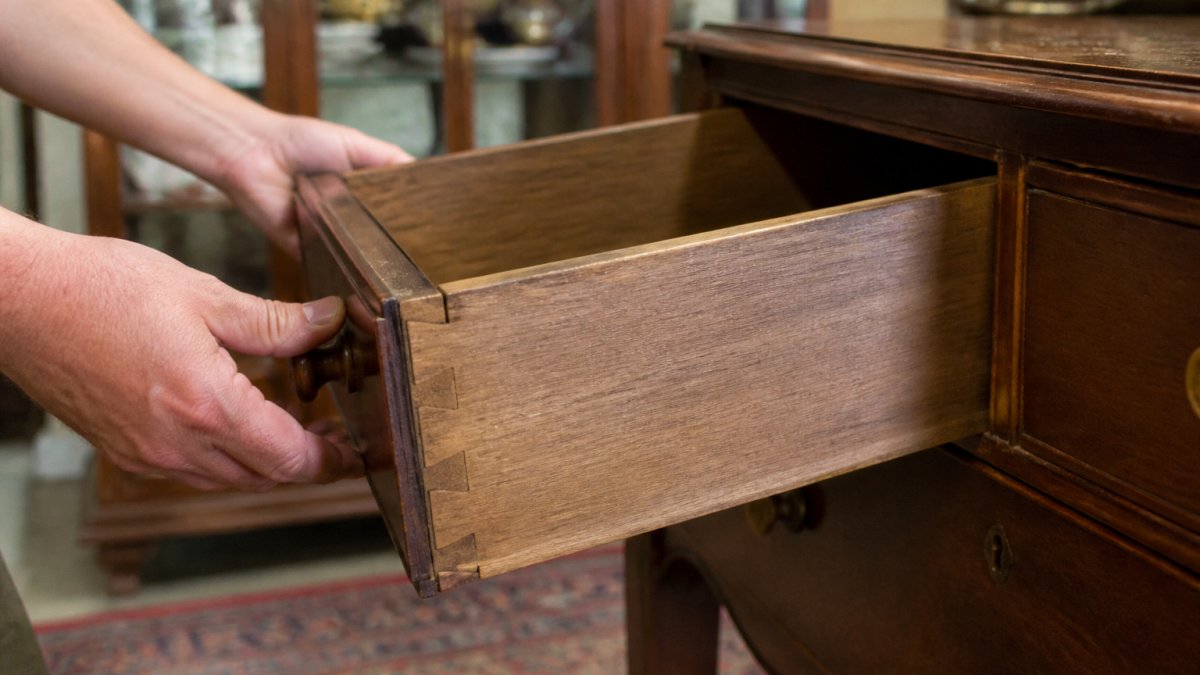
Real antiques show age where nobody sees it. Check for:
- Hand-planing marks on drawer bottoms
- Old dust and grime settled in corners
- Square-cut nails or hand-forged fasteners
- Unfinished back panels with irregular saw marks
A common mistake is judging only the visible face. Fakers refinish fronts beautifully and leave machine marks underneath.
Find the Maker's Mark: Labels, Stamps, and Embossed Metal Tags
Maker's marks confirm origin, but they are easy to fake. A label, stamp, or embossed metal tag should match the piece's style, wood, and era.
Look on drawer sides, the underside of seats, and the back of case pieces. Then ask three questions:
- Does the label style fit the period?
- Is the metal tag corroded in a way that matches real age?
- Does the maker's name appear in reference books for that era?
What most guides miss is that a clean, bright label on a heavily worn piece is a red flag. Wear should be consistent across the whole item.
Antique Furniture Reproduction vs Original: Spotting Fakes and Deliberate Aging
Reproductions are not always dishonest, but deliberate aging is. The problem is that convincing fakes are built to defeat exactly the checks most guides recommend. A faker who knows buyers look at dovetails will hand-cut them. A faker who knows buyers look for wear will add it. That is why no single feature proves authenticity, verification is about whether the evidence is consistent across the whole piece.
How Deliberate Aging Is Actually Produced
Most distressing follows a small set of techniques. Knowing them makes the results easier to read:
- Mechanical wear: Chains, rocks, and sandpaper are used to round edges, dent drawer fronts, and soften chair arms. The result is wear that is too even and too widespread.
- Chemical aging: Acids and stains are applied to darken exposed wood and mimic patina. The color often sits on the surface rather than in the grain, and it can look flat under raking light.
- Faux finish and glazing: New finishes are tinted and glazed to look old. Look in corners and recesses, glaze pools where a real finish would have worn away.
- Salvaged parts: Genuine old boards, hardware, and labels are grafted onto new carcasses. A real 19th-century drawer front on a machine-cut box is a common pattern.
- Copied period details: Hand-cut dovetails, square nails, and period-correct labels can all be reproduced. A correct detail is a clue, not a conclusion.
The Consistency Test
Real wear follows use. Drawer fronts wear where hands pull them. Chair arms wear where hands rest. Feet wear where they meet the floor. Deliberate aging scatters damage evenly, which never happens in real life.
Run a consistency test across the whole piece:
- Wear vs. function: Does the wear sit where a person would actually touch, pull, or set something down?
- Wear vs. age claim: A piece presented as 150 years old should show 150 years of accumulated wear, not a uniform scuff pattern.
- Finish vs. wear: Original finish wears thin at high-touch points. A finish that is uniformly intact but surrounded by dents is suspect.
- Hardware vs. holes: Replacement hardware leaves old screw holes nearby. Original hardware sits in holes that match its age and pattern.
- Wood vs. wood: Secondary woods should be period-appropriate and consistent with the primary wood's era, even when they differ in species.
Do not strip a finish, remove hardware, or sand a surface to "check" a piece. Destructive testing can erase the evidence you need and reduce value. If a piece may be significant, stop and get a professional opinion first.
Why No Single Feature Proves Authenticity
A hand-cut dovetail, a square nail, or an old label each raises or lowers confidence, none of them settles the question. The strongest conclusion comes from many independent clues pointing the same direction. When the clues conflict, treat the piece as unverified and price it accordingly.
How to Date Antique Wood Furniture: Wood Type, Grain, and Wear Patterns
Dating a piece means reading the wood itself. Wood type, grain, and wear patterns narrow the window fast.
Antique Wood Carved Tree Congo Chief's Stool →
Start with these checks:
- Wood type: Oak, walnut, mahogany, and pine each point to specific eras and regions.
- Grain: Hand-sawn wood shows irregular grain lines; modern stock looks uniform.
- Secondary woods: Makers used cheaper wood for hidden parts. A mismatch is normal on originals.
- Wear: Cup rings, dents, and scratches should cluster where people actually used the piece.
The National Park Service preservation guidance notes that original finishes and wear patterns are part of a piece's historic character and should be documented, not erased.
Antique Furniture Provenance: Building a Paper Trail That Supports the Piece
Provenance is the documented history of who owned a piece and when. It supports authenticity in a way visual inspection alone cannot.
Ask for receipts, auction records, estate papers, and old photographs. A strong paper trail includes:
- Prior sale records with dates
- Family or estate documentation
- Restoration receipts naming the work done
- Appraisal letters from qualified professionals
No paperwork does not mean fake. It means you should price and trust accordingly.
When to Book an Antique Furniture Appraisal
Book an appraisal when the stakes are high: a major purchase, an insurance policy, an estate settlement, or a piece with an unclear history. If you are about to buy, it also helps to know the store's return policy for damaged items. A qualified appraiser examines construction, materials, and provenance together, the same evidence you have been gathering, but with the training and reference access to weigh it.
What a Professional Appraisal Actually Involves
A credible appraisal is more than a verbal opinion. Expect the appraiser to:
- Inspect joinery, hardware, finishes, and secondary woods in person
- Compare the piece against reference examples and period records
- Document condition, repairs, and replaced components
- State the intended use of the appraisal (insurance, estate, donation, or sale), because value definitions differ by purpose
- Provide a written report with photographs and a clear description of the methodology
Ask whether the appraiser follows a recognized professional standards body and carries credentials appropriate to the work. Before committing, collectors can compare reputable antique dealers and alternatives. For estate and tax purposes, an independent appraiser with no stake in the sale is the safer choice.
Provenance Documentation: What to Request
Provenance is the documented history of who owned a piece and when. It supports authenticity in a way visual inspection alone cannot. Ask for receipts, auction records, estate papers, and old photographs. A strong paper trail includes:
- Prior sale records with dates and parties
- Family or estate documentation
- Restoration receipts naming the work done
- Appraisal letters from qualified professionals
- Exhibition, catalog, or publication records
No paperwork does not mean fake. It means you should price and trust accordingly. A documented piece and an undocumented piece of identical appearance are not worth the same.
A Verification Workflow With Confidence Levels
Use a simple three-tier system to decide when to escalate:
| Confidence level | What you have | What to do |
|---|---|---|
| Low | Style and appearance only | Treat as decorative; do not pay antique prices |
| Medium | Consistent joinery, hardware, wear, and maker's mark | Request provenance; consider a professional opinion |
| High | Consistent physical evidence plus documented history or expert report | Price and insure as verified |
Most practitioners find that the jump from medium to high confidence is where most disputes occur. That is the point to bring in an appraiser or conservator rather than rely on visual clues alone.
| Situation | Action | Why It Matters |
|---|---|---|
| Low-value decorative piece | Self-check joinery and marks | Cost of appraisal outweighs value |
| Major purchase | Book a professional appraisal | Confirms age, origin, and condition |
| Insurance or estate | Use a certified appraiser | Documentation is required |
| Unclear history | Request provenance first | Paper trail supports the claim |
Shop Verified Pieces at Snellsantiquesstore
Verification is work, and not every collector wants to do it alone. That is where we come in. Every piece we offer is chosen for character and history, and we describe wear, repairs, and condition in detail before you buy.
Our Antique Wood Carved Tree Congo Chief's Stool is a handmade early-1900s piece with intricate carvings, a clear origin story, and honest condition notes. It shows exactly what a verified antique looks like when the details are laid out for you.

Frequently Asked Questions
How can you tell if furniture is genuinely antique?
Look for hand-cut dovetail joints, irregular saw marks, and oxidation inside concealed areas like drawer bottoms. Genuine antique furniture usually shows uneven wear on high-touch points such as armrests and drawer fronts, plus a patina that builds up over decades. A single clue is never enough. Confirm at least three independent signals, including joinery, hardware, and a maker's mark, before you treat a piece as antique furniture.
How do you distinguish antique furniture from a reproduction?
Reproductions often use machine-uniform dovetails, Phillips-head screws, and perfectly straight edges. Deliberate aging shows up as scratches that run in one direction or stains applied on top of a finish instead of worn into it. Check the underside of drawers and the back of the piece, where fakers rarely bother to age the wood. If the wear pattern looks staged, treat it as a reproduction until provenance proves otherwise.
Does antique furniture have to be 100 years old?
In the United States, the common trade definition sets antique at 100 years or older, while vintage covers pieces roughly 20 to 99 years old. That line matters for customs, insurance, and appraisal paperwork. A mid-century teak rocking chair from the 1950s or 1960s is vintage, not antique, even though collectors value it highly. Ask the seller which category they are using before you agree on a price.
When should I hire an appraiser to authenticate antique furniture?
Book an antique furniture appraisal when the price is significant, when provenance documents are missing, or when you plan to insure or resell the piece. Choose an independent appraiser who charges a flat fee rather than a percentage of value, and ask for a written report with photographs and comparable sales. For lower-value decorative pieces, a documented maker's mark and a clear provenance file are often enough.
The hardest part of collecting is trusting what you buy. Snellsantiquesstore curates rare finds, ships each order from Christmas, Florida, and packs every piece so it arrives like a gift. Browse our collections to find a piece with a story you can actually verify. Get started with Snellsantiquesstore and add a piece worth keeping.
