
Last Updated: November 1, 2026
Quick Summary
Antique shipping insurance is a policy that pays you back when a valuable item is lost, damaged, or stolen while it moves from seller to buyer, covering the gap between what a carrier will pay and what your piece is truly worth. It pays the insured value you declared, not the carrier's default limit, so your declared value and insured value should match and be backed by evidence.
- Carrier coverage may suit low-value items, but for high-value shipments weigh whether third-party specialized coverage is appropriate.
- For a true antique with no ready replacement, agreed value can reduce post-loss disputes about what the piece was worth.
- Get a written appraisal for anything high-value that states the valuation basis, effective date, and appraiser's credentials.
- One-time shipping insurance covers a single shipment, is bought at the point of sale, and ends when delivery is confirmed.
- Most policies set a short window to report damage, often measured in days, not weeks.
Table of Contents
- What Antique Shipping Insurance Actually Covers
- Shipping Insurance for Valuable Items: Limits and Declared Value
- How to Calculate the Insured Value of an Antique
- Exclusions and Policy Wording to Watch For
- One-Time Shipping Insurance for Antiques: When It Makes Sense
- How to Pack Fragile Antiques for Shipping
- How to File a Shipping Insurance Claim for Damaged Antiques
- Protecting Your Next Antique Purchase from Snellsantiquesstore
- Frequently Asked Questions
What Antique Shipping Insurance Actually Covers
Antique shipping insurance is a policy that pays you back when a valuable item is lost, damaged, or stolen while it moves from seller to buyer. It covers the gap between what a carrier will pay and what your piece is truly worth.
The core coverage is simple:
- Loss: the shipment disappears and never arrives
- Damage: the piece arrives cracked, chipped, or broken
- Theft: the package is stolen in transit or from a doorstep
Most collectors assume the carrier has them covered. That assumption costs people real money.
Loss, Damage, and Theft During Transit
A shipment is most vulnerable at three points: loading, the sorting hub, and the final delivery handoff. Breakage is a common problem with fragile antiques. Theft is rarer but harder to recover from because a one-of-a-kind piece cannot be replaced.
The key point: antique shipping insurance pays the insured value you declared, not the carrier's default limit. That difference decides whether a claim actually makes you whole.
Carrier Coverage vs. Third-Party Insurance
Carrier coverage is the basic protection built into a shipping service, and its payout is typically limited to the carrier's own liability terms.
Third-party insurance is a separate policy from a specialized insurer and generally requires documentation to support the declared value.
Carrier coverage may suit low-value items. For a high-value shipment, you should weigh whether third-party specialized coverage is appropriate. A homeowners policy may also cover items in transit, but many exclude breakage of fragile goods, so read the fine print first.
Shipping Insurance for Valuable Items: Limits and Declared Value
Declared value is the number you put on the shipping form. Insured value is the amount the policy is written to pay. They should match, and they often don't.
Here is how the two compare:
| Term | What It Means | Who Sets It |
|---|---|---|
| Declared value | Amount written on the shipment | You, the shipper |
| Insured value | Maximum the policy pays | You and the insurer |
| Carrier limit | Default cap on payout | The carrier |
| Deductible | Amount you pay before coverage kicks in | The policy |
Set your declared value too low to save on premium, and you absorb the loss. Set it too high, and the insurer may question the claim. The right number is the item's market value, backed by evidence.
How to Calculate the Insured Value of an Antique
Most claim disputes trace back to one mistake: the shipper picked a number that felt right instead of a number they could defend. Insurers pay the insured value you and the insurer agreed to, subject to the policy's terms. Getting that number right is an important step in the process.
The four valuation bases insurers use
These terms get used interchangeably in casual conversation, but they mean different things on a policy and produce different payouts:
| Basis | What it measures | Typical use | Payout behavior |
|---|---|---|---|
| Agreed value | A dollar figure you and the insurer lock in before shipment, usually backed by an appraisal | High-value, one-of-a-kind pieces | Pays the agreed amount on a total loss, no haggling over market comps |
| Replacement value | What it would cost today to buy a comparable piece in similar condition | Items that can realistically be replaced | Pays to replace, capped at the limit; hard on irreplaceable antiques |
| Market value | What a willing buyer would pay a willing seller today | Estate, resale, and fair-market contexts | Requires comps; disputes are common when comps are thin |
| Declared value | The number you write on the shipping form | Carrier and some third-party coverage | Often treated as a ceiling, not a guarantee, the carrier may still depreciate or invoke limits |
For a true antique, something with age, provenance, and no ready replacement, agreed value can reduce post-loss disputes about what the piece was worth.
A defensible valuation workflow
Work through these steps in order and keep every document:
- Establish current market value first. Pull recent realized sale prices for comparable pieces, same maker, period, condition, and size. Auction result archives and dealer listings are the usual sources. Save the listings or screenshots with dates.
- Get a written appraisal for anything high-value. A qualified appraiser's report should state the valuation basis (agreed, replacement, or market), the effective date, the appraiser's credentials, and the item's identifying details. An appraisal that does not state its basis is weak evidence.
- Add transit-related costs where the policy allows. If the policy covers shipping and restoration, factor those in; if it does not, do not inflate the insured value to cover them, that creates a mismatch the adjuster will flag.
- Document condition before packing. Photograph the piece from every angle, including existing chips, cracks, and wear. Pre-existing damage is a common exclusion, and pre-shipment photos are how you prove the damage happened in transit.
- Match the declared value to the insured value. If the shipping form says one number and the policy says another, resolve it before the package leaves.
- Round to a defensible figure, not a round number. A suspiciously round insured value with no appraisal behind it invites scrutiny.
What documentation the insurer will actually want
A strong valuation file for an antique typically includes:
- A written appraisal stating the valuation basis and effective date
- The original sales receipt or invoice
- Provenance records, prior owners, auction catalogs, exhibition history, family records for inherited pieces
For inherited items, a documented paper trail is generally more useful than a verbal estimate. If you are setting a declared value, it helps to verify a piece's authenticity first so the insured amount reflects a genuine item.
Exclusions and Policy Wording to Watch For
The exclusions decide whether you get paid. Read them before you ship, not after something breaks.
Common coverage exclusions include:
- Improper packing: the insurer may deny a claim if the box was not up to standard
- Pre-existing damage: cracks or wear that existed before shipping
- Inherent vice: items that deteriorate on their own, like certain woods or adhesives
Watch out: a policy that looks cheap often carries a narrow definition of "damage" that excludes hairline cracks and surface loss. Get the wording in writing.
One-Time Shipping Insurance for Antiques: When It Makes Sense
One-time shipping insurance covers a single shipment. You buy it at the point of sale, it ends when delivery is confirmed, and there is no ongoing premium. It suits collectors who buy occasionally rather than shipping constantly.
It makes sense when:
- You are buying a single high-value piece
- The item is fragile or irreplaceable
- The carrier's default limit is far below the item's value
It makes less sense for low-value items where the premium eats into the deal. For a rare piece, the small extra cost is worth the peace of mind.
How to Pack Fragile Antiques for Shipping
Good packing is the cheapest insurance you can buy. It also protects your claim, because most policies require proper packing as a condition of coverage.
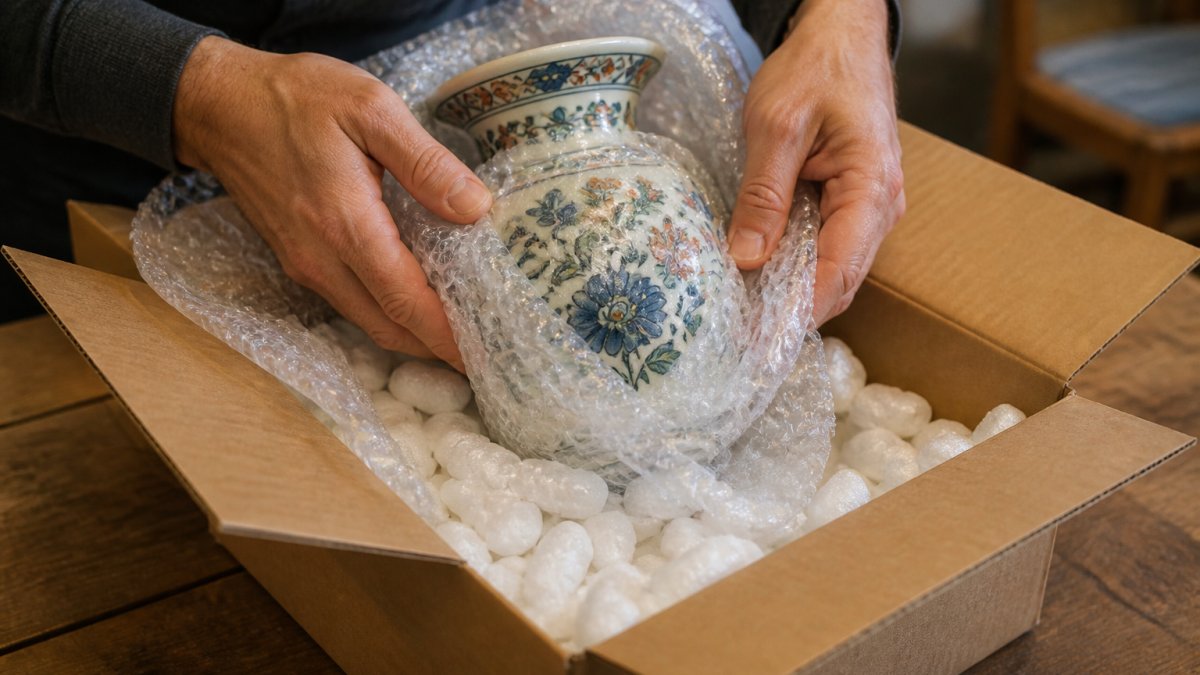
Follow these steps:
- Wrap the piece in acid-free tissue, then bubble wrap
- Fill any hollow areas so the piece cannot flex
- Use a double-box setup with padding between the boxes
- Mark the box fragile and keep it upright
- Photograph the packed box before it ships
A common mistake is skimping on protective materials to save a few dollars. That is exactly where breakage happens.
How to File a Shipping Insurance Claim for Damaged Antiques
A claim is won or lost in the first 24 hours after delivery. Most policies set a short window to report damage, often measured in days, not weeks, and the evidence you preserve before you move anything is what the adjuster will rely on. Treat the unboxing as part of the claim, not an afterthought.
The claim workflow, step by step
- Inspect on camera, the day it arrives. Film the unopened box, then the opening, then the piece and all packing materials. Continuous footage is harder to dispute than a handful of stills.
- Stop and preserve. Do not discard the box, padding, or the damaged piece. Many policies require you to keep them available for inspection and to mitigate further damage, meaning do not attempt repairs before the insurer authorizes them.
- Notify both parties in writing. The carrier and the insurer are separate notice obligations. Missing the carrier's deadline can forfeit the carrier's portion even if the insurer claim is timely. Send notice by a method that creates a record, email with read receipt or a tracked written notice.
- File the claim form with the full evidence package. Attach the appraisal, receipt, provenance, pre-shipment photos, delivery confirmation, and damage photos. Reference the policy number and the shipment tracking number on every communication.
- Cooperate with inspection and salvage. The insurer may send an adjuster or ask you to ship the piece for inspection. Follow instructions on salvage, do not sell or dispose of the damaged item until released.
- Track every response in writing. Keep a log of dates, names, and what was promised. If the claim stalls, a documented timeline is your leverage.
Evidence checklist
- Continuous unboxing video and still photos of the damage and the packaging
- Original sales receipt or invoice
- Insurance appraisal stating the valuation basis
What to expect on timing
Expect weeks, not days. A straightforward damage claim with a complete evidence package typically moves faster than a total-loss or theft claim, which may require a police report and a longer investigation. The two things that most often slow a claim are missing pre-shipment condition photos and late notice, both are entirely within your control.
If your piece arrives damaged, it may help to review the store's return terms so you can weigh a claim against a return.
Protecting Your Next Antique Purchase from Snellsantiquesstore
Before you commit to a high-value piece, it helps to review the details of how it will be packed, shipped, and documented, and to confirm current terms with Snellsantiquesstore directly. For guidance on selecting pieces worth insuring and shipping carefully, see the high-end furniture buyer's guide. You can also compare trusted alternatives before committing.
Frequently Asked Questions
How does shipping insurance work for antiques?
Shipping insurance for antiques is a policy that reimburses you if a piece is lost, damaged, or stolen in transit. You declare the item's value, pay a premium based on that value, and receive coverage up to the policy limit. Unlike standard carrier liability, which caps payouts low, antique shipping insurance can cover the full appraised or market value, provided you have documentation like receipts or appraisals. Always read the policy wording for exclusions before shipping.
Does standard shipping insurance cover antiques?
Standard carrier coverage usually does not fully cover antiques. Most carriers limit liability for fragile or high-value items and exclude breakage, gradual deterioration, or improper packing. A carrier may pay only a fraction of the declared value or deny a claim if the item was not packed to their specifications. For valuable antiques, third-party shipping insurance for valuable items offers broader protection and higher limits, but you must still comply with packing and documentation requirements.
How do you determine an antique's value for shipping insurance?
Insured value is typically based on the item's market value or replacement value, supported by a professional appraisal, sales receipt, or recent auction comparables. For inherited items, an insurance appraisal establishes worth. Declare the full value, not a lower amount to save on premium, because underinsuring means a partial payout at claim time. Keep photos, provenance, and any certificates to prove condition and authenticity.
Does antique shipping insurance cover damage caused by poor packing?
Many policies exclude damage resulting from insufficient or improper packing. If you pack the item yourself, follow the carrier's or insurer's packing guidelines closely: use double-walled boxes, cushion all sides, and separate fragile pieces. Some insurers require professional packing for high-value shipments. If you are unsure, pay for professional packing and keep the receipt; it strengthens your claim and reduces the risk of denial.
Shipping a rare antique always carries risk, and the right coverage turns a potential loss into a manageable one. At Snellsantiquesstore, we curate each piece with care and ship it with the same attention, so your find arrives ready to display. Explore our collections of antiques, jewelry, art, and collectibles, and get started with Snellsantiquesstore to bring a piece of history into your home.
